
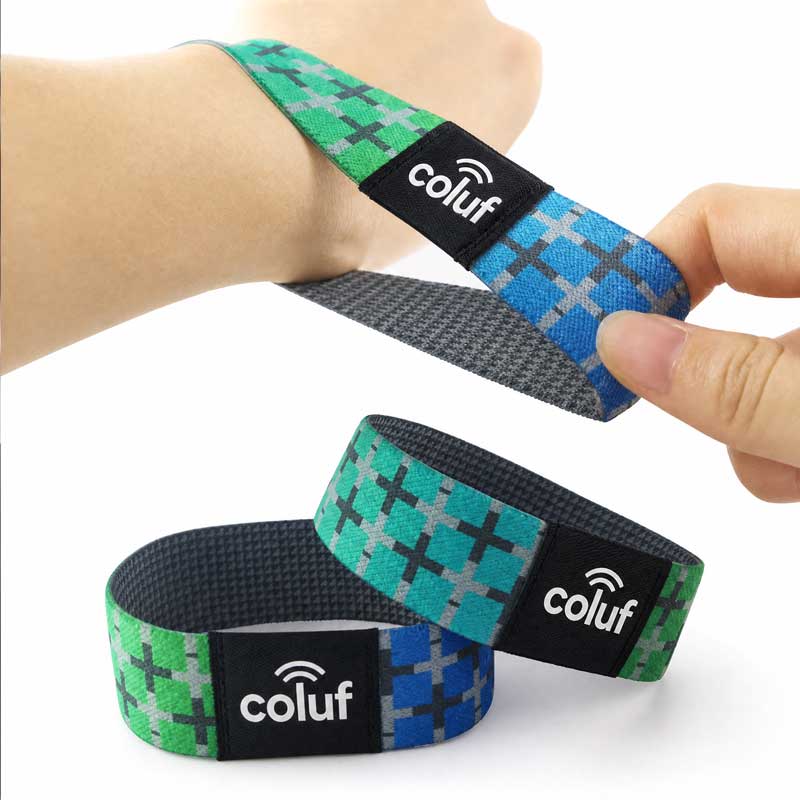
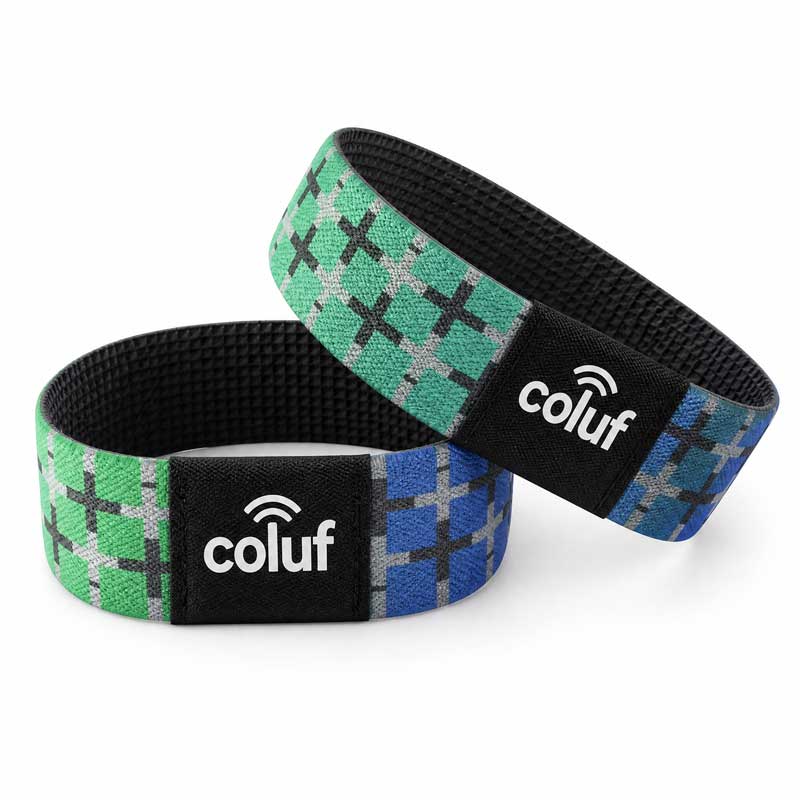
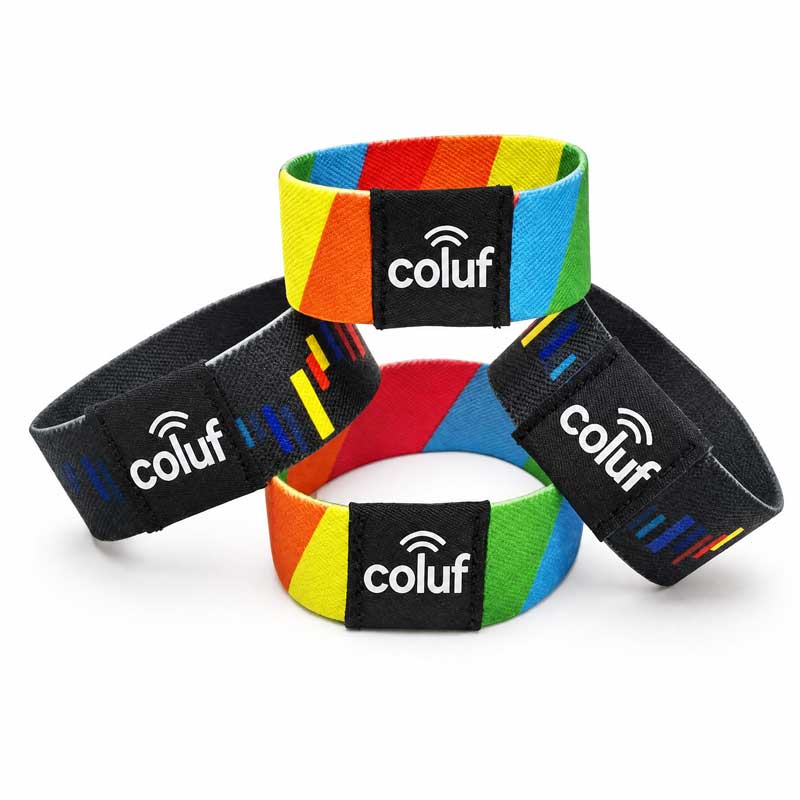
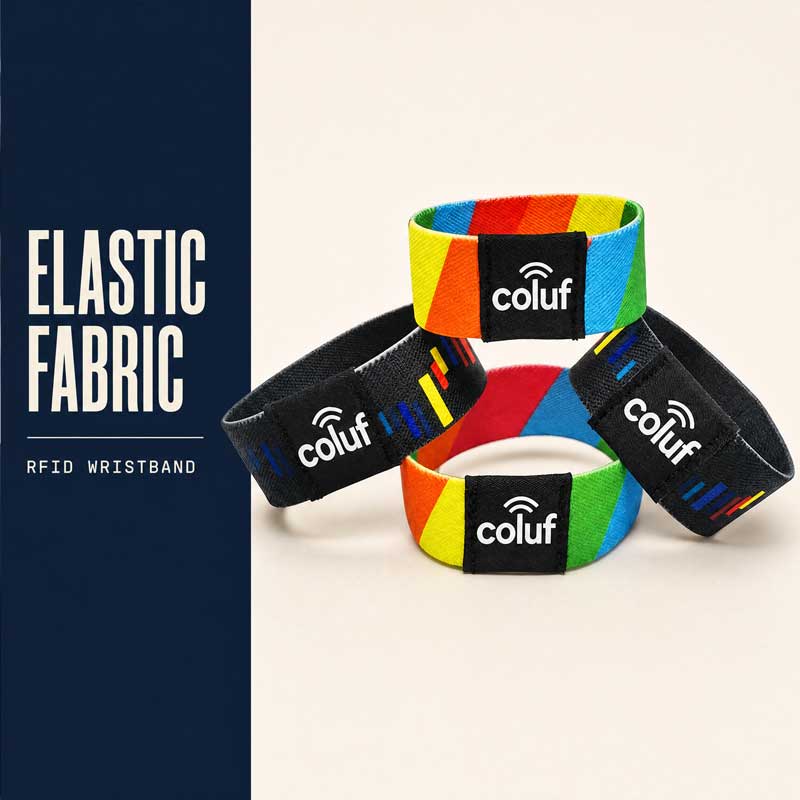
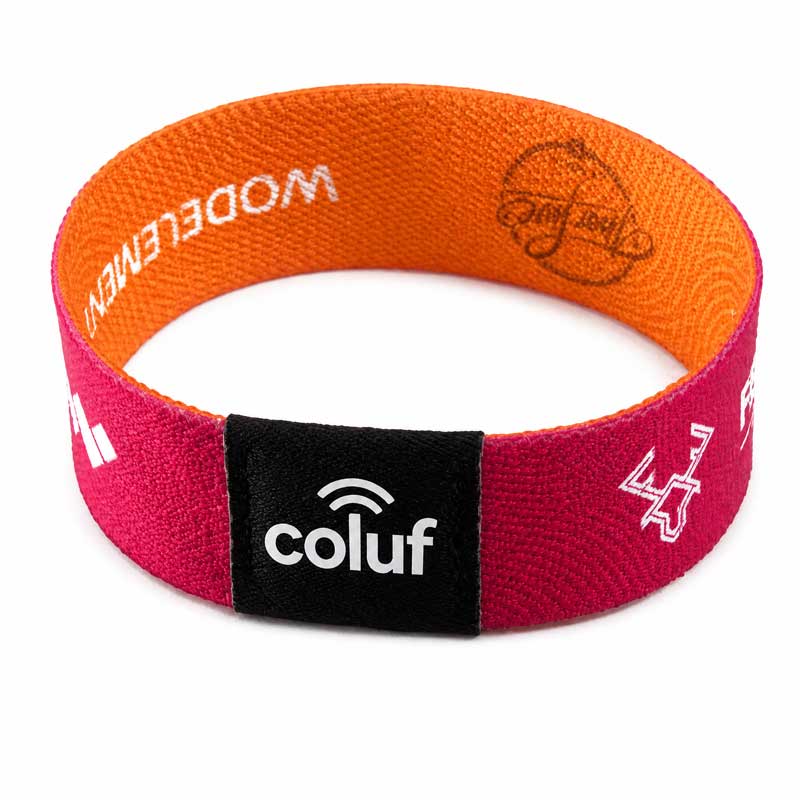
An elastic fabric RFID wristband is a wearable credential built on a blended fabric body and fitted with an RFID inlay, so one wristband can carry access rights, membership data, a cashless token or a scannable digital link. COLUF manufactures these wristbands to order in HF (13.56 MHz) or UHF configuration, with full-color printing and a choice of closure style, and supplies event organizers, venue operators and gym groups worldwide.
| Place of Origin: | Chongqing, China |
| Brand Name: | Coluf |
| Model Number: | RW3 |
| Certification: | CE, ISO9001 |
| Support Services: | OEM & ODM |
| Minimum Order Quantity: | 500 |
| Price(The more you buy, the lower the price.): | $0.3~$1 per piece |
| Packaging Details: | One box of 100 |
| Delivery Time: | 3–7 days(stock),7–20 days(custom) after payment |
| Payment Terms: | TT |
| Supply Ability: | Monthly Production 10+ Million Sheets |
Wristbands are not simply a alternative to cards — they are a different operating model. A card has to be handed out, carried, checked and collected again. A wristband is worn from the moment it is issued until the moment the holder leaves, which removes an entire layer of handling from the gate or reception desk.
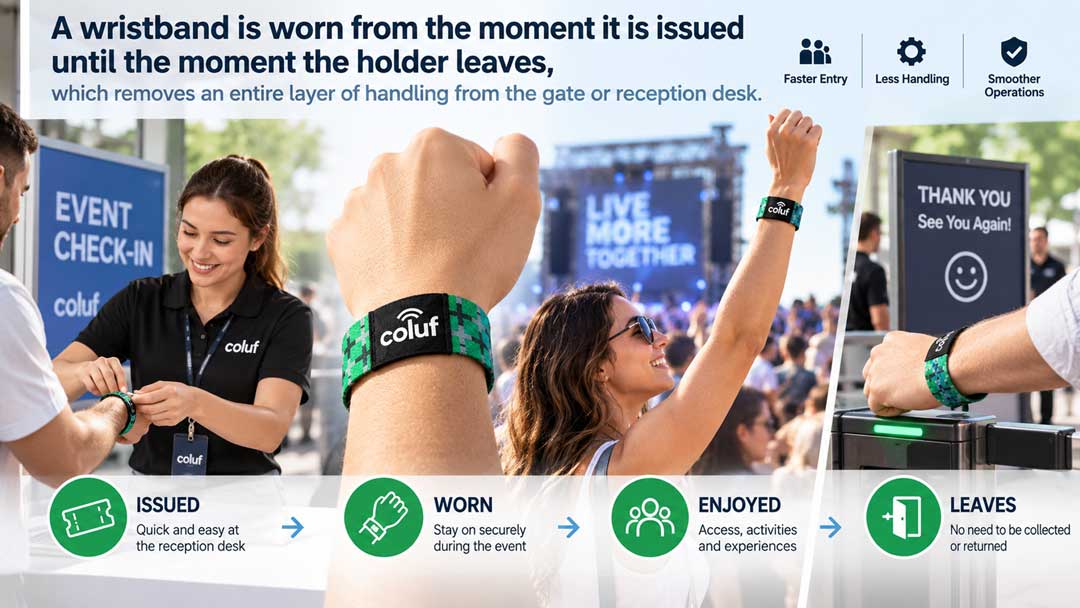
The blended fabric body is the reason the format works for multi-hour and multi-day use. It is soft and stretch fabric, so it sits flat against the wrist instead of catching on sleeves or equipment, and an adjustable fit means one production run covers a wide spread of wrist sizes. That matters commercially: organizers do not have to forecast how many small, medium and large units to order, and gyms do not have to hold stock in multiple sizes. A single SKU, produced in a single print run, covers the whole member or attendee base.
Fabric also lends itself to the way people actually treat a credential at a festival, a tournament or a gym floor. It folds, it moves, and it stays readable on the inside of the wrist where it is less exposed than a card dangling from a lanyard. For teams issuing thousands of credentials in a short window, that translates into fewer replacements at the desk and a faster issue process.
| Material | Blended fabric |
| Finished size | Standard 250mm × 12-25mm (customizable) |
| RFID frequency | 13.56 MHz HF/NFC and 860-960 MHz UHF |
| Chip model | NFC, F08, UHF chips |
| Printing | Full-color CMYK |
| Data options | QR code, logo |
| Use duration | Market positioning commonly targets one- to two-day events |
| MOQ | 500 |
| Sample lead time | 5-7 days |
| Bulk lead time | 10-20 days, depending on quantity |
| Packaging | Cartons |
| Closure | Reusable or tamper-control style, selected during customization |
The wristband body is only half of the system. The chip determines what the credential can do, and the reader determines how it gets read. COLUF supplies both HF and UHF wristbands, and the correct choice follows from your existing or planned infrastructure rather than from the wristband itself.
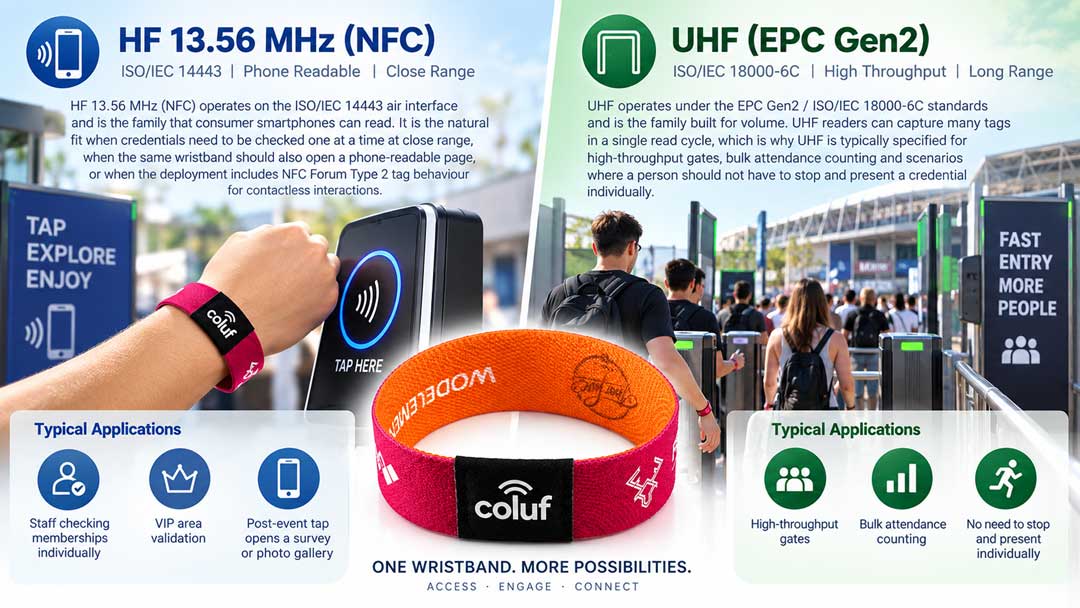
HF 13.56 MHz (NFC) operates on the ISO/IEC 14443 air interface and is the family that consumer smartphones can read. It is the natural fit when credentials need to be checked one at a time at close range, when the same wristband should also open a phone-readable page, or when the deployment includes NFC Forum Type 2 tag behaviour for contactless interactions. Think of staff checking memberships individually, VIP area validation, or a post-event tap that opens a survey or a photo gallery.
UHF operates under the EPC Gen2 / ISO/IEC 18000-6C standards and is the family built for volume. UHF readers can capture many tags in a single read cycle, which is why UHF is typically specified for high-throughput gates, bulk attendance counting and scenarios where a person should not have to stop and present a credential individually.
Read range is not a fixed product characteristic, and we do not publish one as such. It depends on the chip selected and on the reader deployed — reader power, antenna design, orientation and the environment around the gate all play a part. That is why the practical way to specify a wristband is to describe your reader fleet and your gate layout first, then let the chip choice follow.
"We ask every buyer which readers they already own before we quote a chip," says COLUF's production manager. "A wristband that is perfect on one reader can look weak on another. Describing the reader and the gate is what makes the sample — and the eventual production run — predictable."
Music festivals. Wristbands are the standard festival credential because they survive a full day of stages, weather and crowding without being put down and misplaced. With UHF inlay, entry lanes can process arrivals in batches; with HF, each tap can also be tied to a cashless or loyalty action at a bar or merchandise stand.
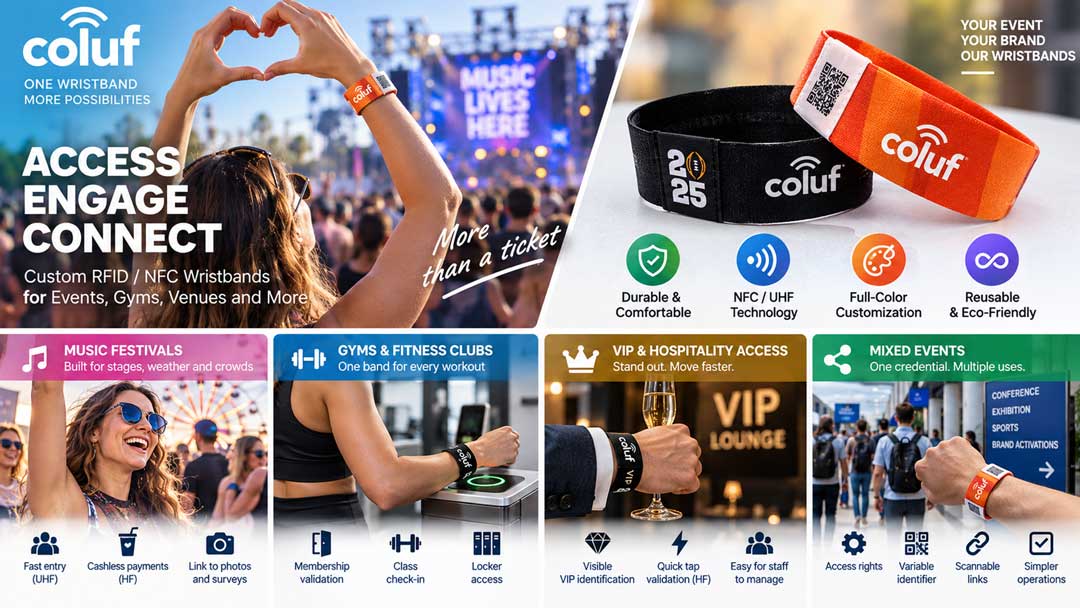
Gyms and fitness clubs. A fabric band that members keep on during training is more practical than a card left in a locker. Membership validation at the turnstile, class check-in and locker access can all run from the same credential, and a reusable closure means the band is issued once and worn for the life of the membership.
VIP and hospitality access. Where credentials need to be visibly different from general admission, full-color printing on a comfortable band makes the tier obvious at a glance. HF tap-checking at a VIP entrance keeps validation quick and lets staff work without dedicated gate hardware.
Mixed events. Conferences with an exhibition floor, sports events with hospitality zones, and brand activations that combine entry control with a scannable call to action all share the same requirement: one credential that handles several jobs. A single wristband can carry access rights, a variable identifier and a printed link, which keeps the operational picture simple for the organizer and the attendee.
1. Send your requirements. Tell us the frequency you need (HF 13.56 MHz or UHF), your expected quantity, your reader environment and your print artwork direction. If you are unsure about the chip, describe the readers you own and the gate layout — that is enough for us to advise.
2. Receive a quotation. We confirm material, chip configuration, print scope, closure style, unit price within the USD 0.30 – 1.00 range and a production window of 7 – 15 working days based on your quantity.
3. Confirm artwork and variable data. Supply your logo and layout files, plus the format of any QR code or barcode data if the run includes variable printing. We confirm the layout, the print side and the placement of the variable field.
4. Approve the proof. Production starts after you sign off on the artwork proof and the technical specification.
5. Production. Wristbands are printed, assembled with the chosen chip and closure, and encoded or serialized as specified. Standard runs complete in 7 to 15 working days depending on quantity.
6. Final check and dispatch. Units are checked against the approved specification before packing, and shipping is arranged to your destination on the delivery terms agreed in the quotation.
What is the minimum order quantity?
500 units per design and configuration. Volume above that threshold can be split across sizes of the same specification rather than requiring separate minimums.
How is the price calculated?
The published range is USD 0.30 – 1.00 per unit. Where a specific order lands inside that range depends on four factors: the fabric and body specification, how much of the band carries print, the chip configuration you select, and the total quantity ordered. Send those four details and you will receive a firm unit price rather than a bracket.
HF or UHF — which should I choose?
Choose HF 13.56 MHz if credentials are checked one at a time at close range, or if you want the band to be readable by a smartphone. Choose UHF if you need many units captured in a single read cycle at a high-throughput gate. If you already own readers, tell us the models — matching the chip to your existing infrastructure is the fastest route to a reliable deployment.
How long does production take?
7 to 15 working days depending on quantity. Artwork approval is the point at which that clock starts, so the fastest route to a short lead time is a clean, approved proof early. Shipping time to your destination is separate and depends on the method agreed in the quotation.
Can each wristband carry a unique code?
Yes. QR codes or barcodes can be printed as variable data across a run, so every unit can map to a distinct ticket, member or booking record. Provide your data in the format agreed at the proofing stage and each band will be printed with its own identifier.
Do you ship internationally?
Yes — COLUF supplies customers in the global market. Air, express and sea freight can all be quoted depending on volume, destination and how tight your event date is. Share your delivery address and required on-site date with the enquiry and the shipping method is built into the same quotation.
Custom Plastic Membership Cards with Magnetic Stripe, Barcode

Postcards | Business Postcards | Custom Postcard Printing Supplier
NFC Stand | Review Stand | Custom NFC Stand Manufacturer
Paper Envelope | Vertical Envelope | Euro Flap Envelope Supplier
Cr80 Custom Printing NFC Review Card
Elastic Fabric RFID Wristbands | Custom Manufacturer & Wholesale Supplier

COLUF specialize in plastic printing, RFID solutions, and commercial printing services for global businesses.
Copyright © Chongqing Colorful Technology Co., Ltd. All Rights Reserved
 EN
EN